

Your shop towel dispenser jams because of the roll, not the bracket
Most jams come from a roll that doesn't fit the dispenser, and a bracket that was never meant to take a grease-handed yank.
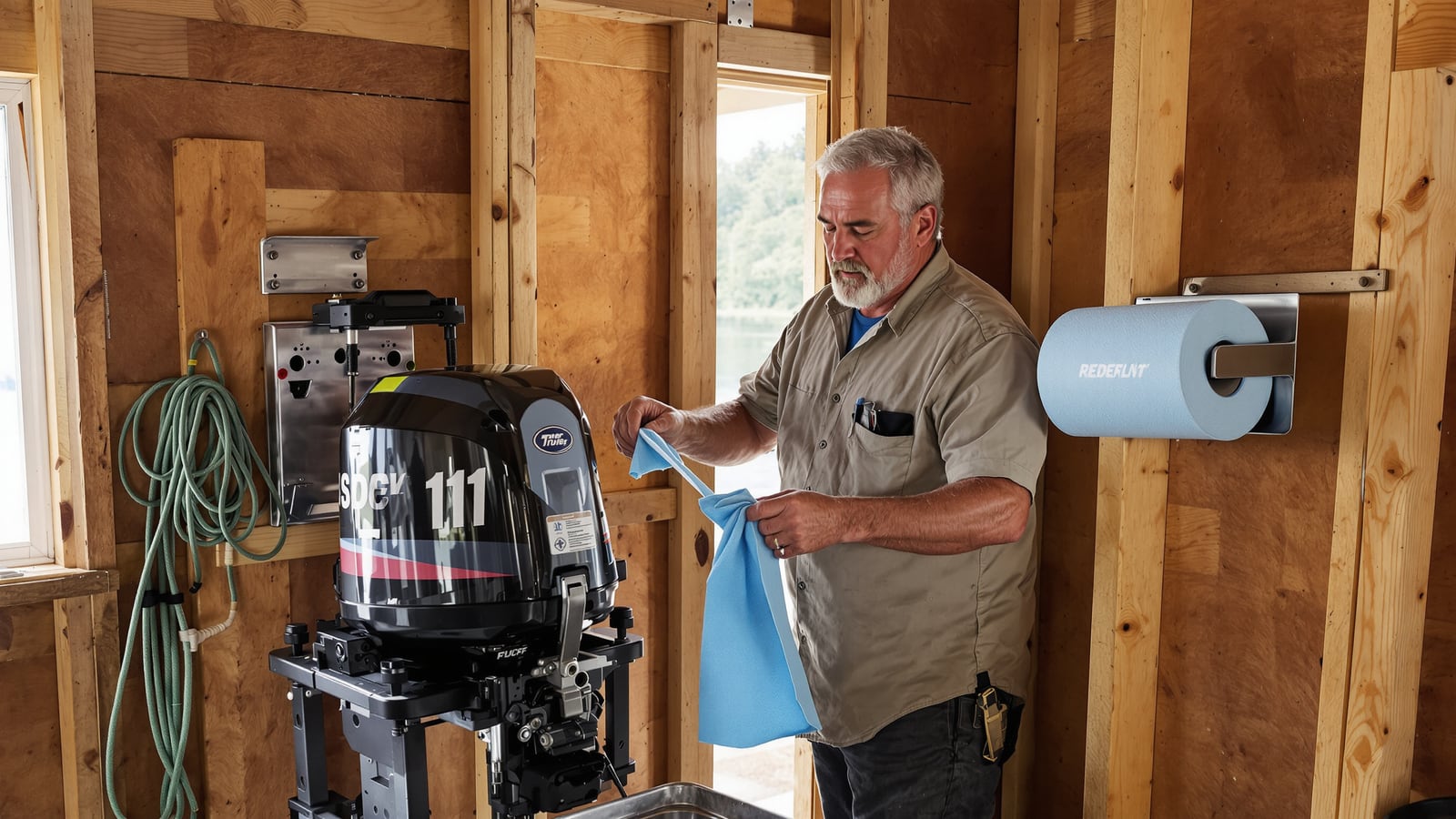
Quick answer: Buy the towels you'll actually keep buying, then buy a steel dispenser built for that exact roll. Screw it into a stud, mount it at elbow height, and keep it away from the grinder. That fixes most jams.
The dispenser usually isn't the problem
You pull a sheet. It tears halfway, the rest of the roll spins loose, and now there's a fat wad of blue paper hanging out of a slot with your hand still wrapped around it. You blame the dispenser. You buy another one.
Same jam, new bracket.
The usual cause is a mismatch. Dispensers are built around a specific kind of roll: a center-pull roll that feeds from the inside, a standard roll that unspools from the outside on a spindle, or a stack of pop-up sheets in a box. Put the wrong one in and it fights you. A center-pull roll on a spindle bracket unwinds in a heap. A wide standard roll in a narrow center-pull housing rubs on the sides and drags.
So start with the towel, not the hardware. Read the packaging on the roll you like. It tells you whether it's center-pull or standard, and what width and core it needs. Then shop for the dispenser that names that format. If the listing doesn't say, move on.
What actually makes one last
A dispenser in a shop takes abuse a kitchen one never sees. You tug it with one hand while the other holds a part. Your fingers are slick. You're in a hurry. The thing gets yanked sideways a dozen times a day.
Look for four things:
- Steel, not thin plastic. Plastic holds up fine on a light-duty job, but the hinge and the mounting ears are where it cracks. A powder-coated steel body shrugs off a bumped elbow and a dropped wrench.
- A metal tear edge. The serrated bar is the part you use hardest. A bar that dulls or bends is why you end up pulling a ragged half-sheet.
- A window or open front. You want to see how much roll is left before you're standing there with dirty hands and nothing to wipe them on.
- Mounting holes that take real screws. Two tiny keyhole slots meant for a drywall anchor won't survive a hard pull. You want enough screw points to spread the load.
None of that's exotic. It's just the stuff cheap units skimp on, because it's invisible in a product photo.
Why humidity matters more than you'd think
Paper swells. A roll that sat in a muggy garage through July can grow just enough to rub the sides of a tight housing, and the sheets stop separating cleanly at the perforation.
A few things help. Keep spare rolls inside their wrapping until you need them. Store them off the concrete floor, on a shelf, because slab moisture creeps up. And if your shop gets truly damp, a center-pull format inside a closed housing protects the paper better than an open spindle does.
Dust has the same effect. Paper picks up grit and overspray, and a gummy edge doesn't feed. Which brings us to where you hang the thing.
Mount it like it matters
Most people stick the dispenser wherever there's a bare square foot of wall. That's how you end up with one above the bench grinder, slowly collecting a fine coat of metal dust and sparks.
Put it at elbow height near where your hands get dirty, but not in the line of fire. Close to the bench, not over it. Near the door or the sink if you've got one, so you can wipe on the way out.
Then find the stud. Drywall anchors hold a picture frame. They don't hold a pull from a man in a hurry with a quart of oil on his glove. Drive the screws into wood, or into a backer board you've mounted across two studs if you want it somewhere between them.
Check the height by standing and pulling once without bending your wrist. If you have to reach up or crouch, you'll end up grabbing at the roll instead of the tail, and that's how the jam starts.
Load it right, pull it right
Half the jams are user error, and the fix costs nothing.
- Remove the damaged outer layer of a fresh roll. The first wrap is often creased or glued and will catch.
- Feed the tail through the opening before you close the cover, so it comes out straight.
- Pull down and slightly toward you, not straight out. A steady draw tears clean at the perforation. A jerk shreds it.
- When one hand's wet or greasy, use the other to hold the housing still. It saves the screws.
And if a sheet does jam, open the cover and fix it. Don't keep yanking. That's how brackets bend and perforations tear three sheets deep.
A note on the used rags
Once you've got a good dispenser, you'll go through towels faster, and you'll end up with a pile of used ones. Treat them with some respect. Rags soaked with certain finishing oils, linseed oil being the well-known one, can heat up and ignite on their own as the oil cures. Don't wad them into the trash. Lay them flat outdoors to dry, or keep them in a metal can with a tight lid, and follow whatever the product label says.
What we'd buy, what we'd skip
We won't name a model, because the right one depends on your roll. The rule holds anyway.
Buy: a steel dispenser matched to the format of the towel you already like, with a metal tear edge, screw-through mounting and a way to see the roll.
Skip: the cheapest plastic unit with a vague listing, anything that doesn't say what roll it takes, and any "universal" holder that promises to fit every format. Universal usually means it fits none of them well.
If you're the type who likes gear that earns its keep, it's the same principle we hit in smart home kit that earns its place, and kit that just sits there. And if you've ever bought on a spec sheet and regretted it, buy headphones for your week, not for the review scores makes the same case for a different gadget: buy for how you'll really use it.
Leave it better
One more thing, and it costs nothing. When you pull the last sheet, don't leave the empty core on the spindle for the next guy. Swap the roll. Wipe the greasy thumbprints off the housing. Sweep the shreds off the floor under it.
It takes forty seconds. The next person who reaches for a towel with both hands full of someone else's job will know a decent man works in this shop.
Dean Shaw
Gear & Garage
Reads the warranty, the parts list and the long-term owner reviews before anything else. Trucks, tools, watches, and the cheap version that costs more.

Watch
Watch how it's done
Picked for this article.
From channels we rate. Plays on YouTube.
One Minute Workbench
Shop Towel Holder with Built In Shelf
Read next